Wykład Dr. Mélanie Sadozaï już w kolejny "Piątek na Historycznym"
Już dzisiaj zapraszamy na kolejne spotkanie z cyklu Piątek na Historycznym".
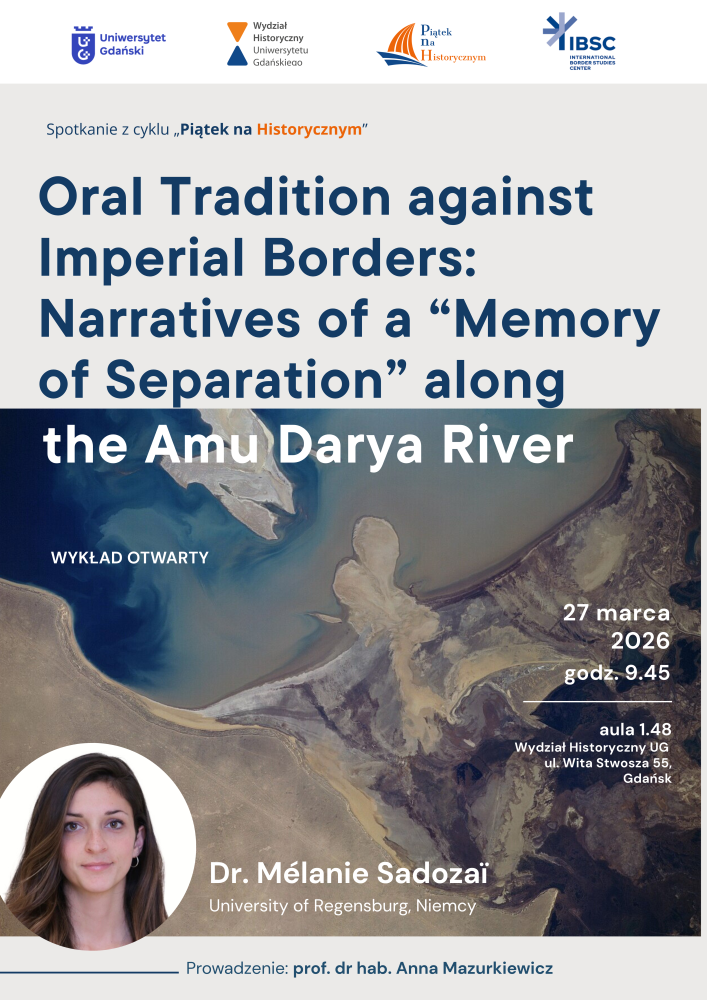
27 marca będziemy gościć Dr. Mélanie Sadozaï z University of Regensburg w Niemczech, która wygłosi wykład "Oral Tradition against Imperial Borders: Narratives of a “Memory of Separation” along the Amu Darya River".
Spotkanie poprowadzi prof. dr hab. Anna Mazurkiewicz, na zaproszenie której Dr Sadozaï wizytuje na UG.
Mélanie Sadozaï is a postdoctoral researcher at the University of Regensburg (Germany). Her work focuses on the many forms of cross‑border relations between Central Asia and Afghanistan, with a focus on the Pamir region, based on ethnographic research conducted there since 2014. Her first book, drawn from her doctoral dissertation, is titled Tajikistan–Afghanistan: A Border at the Edge of the Pamirs (Presses universitaires de la Méditerranée, 2026, published in French). She is also leading a project funded by the Leibniz Association, titled "The Legal Constitutions of Borders", where she and her team investigate the nexus between the law and border realities along three borderlands of Europe.
Abstract
This article examines the discourses of communities residing along the border that today separates Tajikistan and Afghanistan, focusing on their perceptions of its origins and consequences. Established in 1895 during the “Great Game” between the Russian and British Empires along the upper course of the Amu Darya, this boundary was long construed as a political and cultural demarcation, particularly throughout the Soviet era. Yet, the lived experiences of populations whose personal trajectories were disrupted by this line remain absent from written sources. To address this gap, the study draws on interviews with border communities to reconstruct an oral tradition of the border’s history, and to explore the collective memory and representations of inhabitants on both banks. The narratives collected reveal a persistent contestation of the imperial delimitation and articulate a “memory of separation,” reflecting the experience of an administrative frontier perceived as a form of top-down imposed violence. By mobilizing this oral tradition, the article proposes an approach that gives voice back to local communities, showing that the border, far from being a mere state marker, is also a space for identity negotiation and discursive resistance.